Thursday, June 2, 2011

Time to Reflect on What is and What Might be Coming

Leading on from my previous blog I thought i would discuss some of the findings of my fellow academics who over the past week have sought out what they consider to be "New Media" forms. My own findings uncovered two fashion-centric media forms, which blur the lines of what is human and what is electronic. The first of these is Issey Miyake's Spring/Summer 2005 animation 'A-POC INSIDE'. The piece utilizes motion capture to postion the letters of "Issey Miyake" at what we assume are the extreme points on the contours of the body. I have posted the video below.


For me it is a struggle to identify the piece as anything other than organic. Even when the dots and letters begin to flow sideways at different rates along a horizontal plane the animation still maintains the motion of something incredibly human. Regardless of Miyake's intention it seems that human data transduced into an uncommon medium does not alter what is at the essence of human movement, which is fluidity. Even through electronic means we cannot escape what it means to be human.

But we can use new media forms to break down what has constrained us as human beings in the past. The ADIDAS 3D mapping venture explores the relationship between man and architecture and how the dislocation of authority from certain structures can be not only an entertaining experience but also a cathartic and liberating one.


Architecture is increasingly being considered and integral part of new media forms. From spatially aware electronics to geo-tagging and augmented reality, our perception of the boundaries that architecture traditionally establish is being turned inside out. We are no longer confined to another persons idea of how architecture should function.

My final example brings us back to the theme of the beauty within the machine. It comes from the much-loved, but unfortunately now deceased Alexander McQueen. His final showing incorporated robotics and prosthetics so as to suggest where humanity and technology might be heading in an ecologically distressed world.


McQueens vision of a world aquatic looks enthusiastically towards a globe without polar ice-caps, but also examines the ongoing struggle between surveillance and those being watched. It questions the definition of voyeurism suggesting that as we come to view more things from more angles we are returning to a natural state of inquisition, but at the same time extending our capability of doing so into the machine.

From a personal understanding it is not so much about considering the binary opposition between man and machine, but rather coming to the realisation that machines are an extension of our desires and expression and that they offer the opportunity of experimentation beyond the biological capacity of our bodies. The relationship cultivates a fertile space of creativity with the ever present possibility of better understanding ourselves and how we might relate to others.

Tuesday, May 24, 2011

The Beauty of the Unseen


I imagine that for many, as it is for myself, electronic art is in most ways beautiful, but at the same time disturbing. It generates a precision that is humanly unachievable. Perfection can be the only result as the electronic medium will not question itself. It may have inputs, but the outputs are already determined through the unbending science behind the technology. This for some creates a vast distance between art and artist. How can a programmer strive towards a vision that exists in their mind if the mediums used to create it do not in any visual way reflect the final piece and how might we come to appreciate something so seemingly artificial?


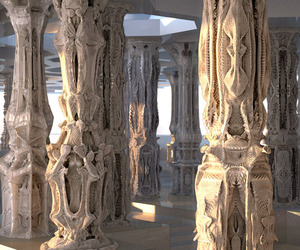
Perhaps then it is wise to take note of Andrew Murphie's suggestion that we consider aesthetics rather than beauty, as beauty is too subjective to deal with the evolving frontier of electronic art (Murphie, 2011). We are at a point (for me at least), where the electronic and the organic are finding a common ground of expression. Looking at the Japanese Humanoid robot (Spaceweaver, 2010) and Michael Hansmeyer’s explorations in design architecture (Atley et. al, 2011), one cannot help but be reminded of things that are living.
Picture care of Atley & Folkert 2011

Hansmeyer's towering cardboard carvings have a tribal and botanical feel to them, which is both moving and unnerving at the same time. This makes me question the assumed distance between the electronic as the artificial and the biological as the authentic. There seems to be a closer relationship between the aesthetics of this contemporary artwork and the whole history of artistic expression than some of us might be willing to admit. We are after all simply organic computational devices capable of reproducing our thoughts within a physical space, so maybe what makes us so uncomfortable is dealing with technologies that have the potential to replicate the human experience in artistically exceptional ways that possibly move beyond what we can achieve without their assistance.
For me the era of electronic art represents a looming chapter of exceptional artistic creation, unparalleled beauty and limitless exploration of the digital aesthetic.

Bibliography:
Kasky, Atley G. & Folkert, Gorter. (2011) 'On the Generation of the Previously Unseen' on But Does it Float?, http://butdoesitfloat.com/1121006/On-the-generation-of-the-previously-unseen, accessed 24 May 2011
Murphie, Andrew (2011) 'Media Ecologies' lecture notes distributed in Advanced Media Theories at The University of New South Wales, Kensington Campus, 23 May 2011


Spaceweaver (2010) 'Introducing Japan's New Singing Robot', in AICultureRoboticsTechnology http://k21st.wordpress.com/2010/10/15/introducing-japans-new-singing-robot/, accessed 24 May 2011


Tuesday, May 17, 2011

Now that I look Back I Realise.....

Game playing according to Jane McGonical is the way we are going to save the world (McGonical, 2010). Her “Epic Win” in gaming is the point at which positive human agency reaches its paramount. We are our best person, our most heroic, altruistic and effective selves when we reach this epic win realization. She argues that the gaming platform offers an uninhibited strategic experiment that generates more problem solving potential than that of the real world. In order for the problems of the world to be solved this experience needs to be transferred into temporal reality.

So for McGonical it is not the game, but the optimism that is generated through game playing that supports the potential for positive change. Gamers are happy to work hard, to pool extensive intellectual resources so as to develop sustainable worlds. The way to survive the next century will be to adopt the strategies used by gamers to solve pressing contemporary issues.

The structural blocks of reality work against this collaborative effort, so much so that we are killing ourselves with disagreement and political red tape. No wonder people are escaping to online gaming worlds! These structural blocks are eliminating the potential for many of the theories that we have discussed to come together to solve problems. From the commons, to more dynamic ecologies, potential transversals of collective and effective pools of thought, the solution is there, but is inhibited by a history of failure fatigue.

I have often marveled at my fathers genius. He can make any farming machinery that he needs with extremely limited resources. This is his gaming world and his creations are his "epic win". He is fortunate enough to be able to bring together a vast knowledge and the know-how of his like-minded and not so like-minded friends, to generate an almost limitless pool of engineering expertise and he is just one person. He is not university educated, but instead has leveraged his relationships with others to learn the intricacies of hydraulics, structural engineering, metal forging and load bearing simply by asking “How can I achieve this objective?”


Creating a community of communication and knowledge sharing, and using the ideas of the past to solve the problems of the future…….could it be this simple?


Bibliography:

McGonical, Jane (2010), "Jane McGonical: Gaming Can Make A Better World" at TED2010 Conference, 20 Feb 2010, Monterey California, <http://www.ted.com/talks/jane_mcgonigal_gaming_can_make_a_better_world.html> , accessed 16/05/11


Tuesday, May 3, 2011

Week 9 Micropolitics, Opensource and Gov 2.0

What can we do with all these people? From a conventional government perspective we can organise them into a catalogue of details, from health records to tax payments and geospatial movements. They can be commodified into those with jobs and those without or skilled professionals and unskilled labourers. From a Gov2.0 perspective we might consider that these biological commodities have something to contribute back into the system, but the point at which we might consider Gov2.0 as faltering or even dead in the water is the foundational system of a top down approach consisting of traditional governments viewing themselves as the paramount power within the ecology.

I propose then that the title of this relatively new movement 'Gov 2.0'  should not stand for the reinvigoration of government but of governance. To address what governance is we need to examine all the groups, concepts, social ideals and movements that shape organised society. It is not enough to point to a particular group and say "this is what you contribute" or "contribute this", but instead we should examine the matrices involved in their relationships with one another, so that we might understand the sorts of outputs their collective resource could potentially generate.

We can easily apply Elinor Ostrom's research into 'collective pool resource' (CPR) here to understand a multi-directional approach to governance and where gov2.0 might be taking us (Ostrom, 2010). Consider an ecology of education consisting of teachers, students, parents, government departments and politicians an already vast ecology of knowledge sharing. Now introduce field researchers and business professionals to the mix and watch the curriculum grow, but for this growth there needs to be a platform developed for open communication with a structure geared towards an openly arrived at end goal. To illustrate how governments can stuff this up we might look at the then Education Minister Julia Gillard's development of league tables for schools. Rather than developing a platform for the input of ideas about solutions, the league tables highlight the problem instead of engaging the ideas of parents and teachers as to what might be the solution. This example demonstrates the danger of a government trying to '2.0' itself purely through the availability of technology rather than opening up the field to input from those whose work has the greatest impact.

Maybe open source education is the answer or maybe it is equally dangerous. This is worthy of passionate discussion.

Ostrom, Elinor (2010) ‘A Multi-Scale Approach to Coping with Climate Change and Other Collective Action Problems’, Solutions: for a sustainable and desirable future 1(2), <http:// www.thesolutionsjournal.com/node/565>, accessed May 3 2011

Tuesday, April 19, 2011

Week 8: The Fate of the State

"Passive and active framing!" That is what we decided were the two types of framing when my friends and I discussed framing as a concept last week. There is the passive framing, which is our negotiation with the basic living scenarios we are presented with every day and then there is active framing, which is a concerted effort on the part of third parties to shape the way we respond to these scenarios. The more I thought about these ideas that we had come up with the more i realised that rather than being distinct processes they were actually more closely linked than we had originally realised. What does this mean for new structures of participatory government or 'State 2.0'? If we are shown the frames by which political discourse is shaped, is a process that hides campaign and government secrets in plain sight really just duping us?

Considering Bob Ellis’ piece ‘Sleepless in Canberra’ it seems that excessive transparency of frames and the 24hour news cycle is distracting politicians from state administrative and policy matters and forcing them into a never ending process of defending the foundational processes of politics (Ellis, 2010). Take for example the endless refresh of state Labour leaders in New South Wales. While admittedly a political arena rife with corruption, the introduction of fresh blood was still not enough to stifle the unending media barrage, while the states productivity and infrastructure development ground to a halt. The never-ending dissection of private affairs over policy matters meant that any attempt at implementing substantial works was buried. The sole policy concern of media commentators then becomes budgetary blowouts. (there has rarely been a state project that hasn’t seen a budgetary blowout)

I am not trying to suggest that transparency of governments is an unnecessary evil, but it does raise questions of how much of the political process does the public need to know about. Certainly questionable funding contributions are on the list, but maybe transparency should be addressed from a ‘need to know’ not ‘always must know’ basis.  A round the clock media establishment feeds our addiction to transparency and distracts us from what is really important which is policy agenda and implementation.

Ellis, Bob (2010) ʻSleepless in Canberraʼ The ABC, Drum Unleashed <http:// www.abc.net.au/unleashed/35116.html> accessed 18 April 2011

Tuesday, March 29, 2011

Week 5 Media Ecologies - Augmented and Virtual Realities


Augmented reality and virtual reality bring to fruition objects that do not materially exist. (Wikipedia, 2010)We could assume this of our own temporal realities in that the only things that exist are those that illicit some kind of physical or psychological response from us (Murphie, 2011) They exist because we create them through perception. Therefor all things in the world are based upon multiple virtual realities and in fact upon as many virtual realities as there are minds to construct them. However there are other ways of thinking of the virtual including the collapsing of time-space through technologies of broadcast, biometric data driven animation and spatially aware technologies such as GPS and smart phones all of which alter our perception of the temporal reality. A mountain becomes a dot on a map or a Krispy Kreme has a virtual donut hovering over it when viewed through an application such as Layar. International colleagues are framed by the borders of a screen and the aperture of the lens. All of these are “virtually” lived experiences, but are not quite in the realm of true reality, if there is such a thing.

So where does this leave us in a world of haptic screens and virtualising machines? Is the new reality fast becoming one that is entirely virtual? Chris Grayson seems to think so. The proliferation of augmented reality technologies into our most loved devices is only the beginning according to Grayson who sees heads up displays and 3D overlays becoming major elements of our ongoing cyborg transformation (Grayson, 2009). Grayson points out that the majority of attempts made at an augmented reality experience have been from a capitalist perspective and thus sales focused. I can certainly see a varied application in search and rescue operations where rescue teams unable to penetrate disaster affected areas could deliver visual based evacuation information to victims on the ground through an easily modified data set distributed to AR capable devices.

But as Andrew Murphie points out in 'The World as Clock: The Network Society and Experimental Ecologies' these technologies do not occur within a vacuum. They are born of the intersections between various media ecologies and social affordance. (Murphie, 2004) The CGI donut is born of advertising, the action of the user from the concept of the tourist and the technology that supports AR is already made of hundreds if not more media ecologies and the freedom to capture an image is a highly political construct. All of these individual elements, which exist as far more than their whole, operate at different frequencies which Murphie argues are able to synchronise or “transduce” into a particular ecology, (Murphie, 2004:120) which deliver the social, cultural, geographical, technological, physical and psychological phenomenon of virtual or augmented realities which are massively reshaping our experience of the world around us.

Bibliography:

Anon. (n.d.) ‘Virtual Reality’, Wikipedia, http://en.wikipedia.org/wiki/Virtual_reality

Grayson, Chris (2009) ‘Augmented Reality Overview’, GigantiCo http:// gigantico.squarespace.com/336554365346/2009/6/23/augmented-reality- overview.html

Murphie, Andrew (2004) ‘The World’s Clock: The Network Society and Experimental ecologies’, Topia: Canadian Journal of Cultural Studies, 11, Spring

Murphie, Andrew (2011) 'Media Ecologies' lecture notes distributed in Advanced Media Theories at The University of New South Wales, Kensington Campus, 28 March 2011

Tuesday, March 22, 2011

Extending the Mind, Natural Memory and Virtual Memory


As  someone with a memory which fails to think in a linear fashion as others do and who can never remember important dates or times it would seem that I am a prime candidate for technologies that alleviate this experience through hypomnesis as described by Bernard Steigler in ‘Anamnesis and Hypomnesis’. (Steigler, 2008) I forget doctors appointments meetings with friends, bill payments etc., but somehow in the midst of all this I am able to remember long sequences of numbers. And not just some sequences but many, from my medicare card number to credit card details and the exhaustively long sequence required using Telstra Telecard. For me the externalising process involves a singing of the sequence so as to create a readily recalled tune. Each phone number rather than being merely digits is a song. This is much like Alan Kay’s Youtube video on learning where a woman learned to play tennis, not through examining the technical aspect of the forehand, backhand and serve but through externalising her mind through vocalisation. (Kay,2008) My experience with missed appointments might then be due to the fact that the part of my brain responsible for such functions doesn’t speak the language of the appointment (Kay 2008), which also is in the unfortunate position of not being particularly melodious. Maybe the part that does store this information is the same area that lights up when I listen to a song as suggested by Alva Noe in her work titled ‘Does Thinking Happen in the Brain?”. (2010, 13:7) If this is the case, and I have no hope of singing all my appointments into my head, then technologies that help extend the mind might help.
I assume that many people retain and protain simultaneously as I do, but in the highly visual world in which I live I do not require technologies to assist me in my pursuit of the perfectly merchandised window (this is my day job) yet I still use them. If merchandising is to be considered sculpture then what I am undeniably doing is externalising my mind. The relationship between the evolving display and my memory is reciprocal. A medium must be reached between what is imagined and what is possible. The end result is an articulation of both my retention and protention. I have a vision of what might evolve and the memory of how to achieve it, but at the same time I use my phone to take photos of interesting arrangements in other locations so that If I don’t quite remember then a piece of technology will. This is what Andrew Murphy refers to as the dynamic ecology of virtual memory, an interplay between natural and virtual memory. (Murphie, 2011)
This also raises issues surrounding the concept of the “cyborg” in that my phone becomes both a mental and a biological extension of myself. (Clark, 2010) I welcome discussion on this point.


References:
Clark, Andy (2010) ‘Natural-born Cyborgs? Reflections on Bodies, Minds and Human Enhancement’, http://vimeo.com/16717229 (accessed 22/3/11)
Kay, Alan, (2008) ‘Alan Kay on Learning’, Youtube http://www.youtube.com/watch?v=50L44hEtVos (accessed 22/3/11)
Murphie, Andrew (2011) ‘Lecture Four Globalisation of Memory via Media (pdf)’, http://arts3091.newsouthblogs.org/files/2011/02/3091_2011_lec4_memory_web.pdf , (accessed 22/3/11)

Noë, Alva (2010) ‘Does thinking happen in the brain?’, 13:7 Cosmos and Culture http://www.npr.org/blogs/13.7/2010/12/10/131945848/does-thinking-happen-in-the- brain (accessed 22/3/11)
Stiegler, Bernard (n.d.) (2010) ‘Anamnesis and Hypomnesis: Plato as the first thinker of the proletarianisation’ http://arsindustrialis.org/anamnesis-and-hypomnesis  (accessed 22/3/11)