Tuesday, May 24, 2011

The Beauty of the Unseen


I imagine that for many, as it is for myself, electronic art is in most ways beautiful, but at the same time disturbing. It generates a precision that is humanly unachievable. Perfection can be the only result as the electronic medium will not question itself. It may have inputs, but the outputs are already determined through the unbending science behind the technology. This for some creates a vast distance between art and artist. How can a programmer strive towards a vision that exists in their mind if the mediums used to create it do not in any visual way reflect the final piece and how might we come to appreciate something so seemingly artificial?


Perhaps then it is wise to take note of Andrew Murphie's suggestion that we consider aesthetics rather than beauty, as beauty is too subjective to deal with the evolving frontier of electronic art (Murphie, 2011). We are at a point (for me at least), where the electronic and the organic are finding a common ground of expression. Looking at the Japanese Humanoid robot (Spaceweaver, 2010) and Michael Hansmeyer’s explorations in design architecture (Atley et. al, 2011), one cannot help but be reminded of things that are living.
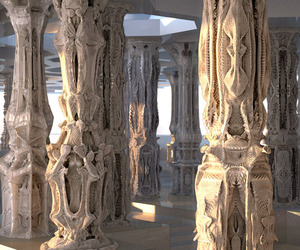
Picture care of Atley & Folkert 2011

Hansmeyer's towering cardboard carvings have a tribal and botanical feel to them, which is both moving and unnerving at the same time. This makes me question the assumed distance between the electronic as the artificial and the biological as the authentic. There seems to be a closer relationship between the aesthetics of this contemporary artwork and the whole history of artistic expression than some of us might be willing to admit. We are after all simply organic computational devices capable of reproducing our thoughts within a physical space, so maybe what makes us so uncomfortable is dealing with technologies that have the potential to replicate the human experience in artistically exceptional ways that possibly move beyond what we can achieve without their assistance.
For me the era of electronic art represents a looming chapter of exceptional artistic creation, unparalleled beauty and limitless exploration of the digital aesthetic.

Bibliography:
Kasky, Atley G. & Folkert, Gorter. (2011) 'On the Generation of the Previously Unseen' on But Does it Float?, http://butdoesitfloat.com/1121006/On-the-generation-of-the-previously-unseen, accessed 24 May 2011
Murphie, Andrew (2011) 'Media Ecologies' lecture notes distributed in Advanced Media Theories at The University of New South Wales, Kensington Campus, 23 May 2011


Spaceweaver (2010) 'Introducing Japan's New Singing Robot', in AICultureRoboticsTechnology http://k21st.wordpress.com/2010/10/15/introducing-japans-new-singing-robot/, accessed 24 May 2011


Tuesday, May 17, 2011

Now that I look Back I Realise.....

Game playing according to Jane McGonical is the way we are going to save the world (McGonical, 2010). Her “Epic Win” in gaming is the point at which positive human agency reaches its paramount. We are our best person, our most heroic, altruistic and effective selves when we reach this epic win realization. She argues that the gaming platform offers an uninhibited strategic experiment that generates more problem solving potential than that of the real world. In order for the problems of the world to be solved this experience needs to be transferred into temporal reality.

So for McGonical it is not the game, but the optimism that is generated through game playing that supports the potential for positive change. Gamers are happy to work hard, to pool extensive intellectual resources so as to develop sustainable worlds. The way to survive the next century will be to adopt the strategies used by gamers to solve pressing contemporary issues.

The structural blocks of reality work against this collaborative effort, so much so that we are killing ourselves with disagreement and political red tape. No wonder people are escaping to online gaming worlds! These structural blocks are eliminating the potential for many of the theories that we have discussed to come together to solve problems. From the commons, to more dynamic ecologies, potential transversals of collective and effective pools of thought, the solution is there, but is inhibited by a history of failure fatigue.

I have often marveled at my fathers genius. He can make any farming machinery that he needs with extremely limited resources. This is his gaming world and his creations are his "epic win". He is fortunate enough to be able to bring together a vast knowledge and the know-how of his like-minded and not so like-minded friends, to generate an almost limitless pool of engineering expertise and he is just one person. He is not university educated, but instead has leveraged his relationships with others to learn the intricacies of hydraulics, structural engineering, metal forging and load bearing simply by asking “How can I achieve this objective?”


Creating a community of communication and knowledge sharing, and using the ideas of the past to solve the problems of the future…….could it be this simple?


Bibliography:

McGonical, Jane (2010), "Jane McGonical: Gaming Can Make A Better World" at TED2010 Conference, 20 Feb 2010, Monterey California, <http://www.ted.com/talks/jane_mcgonigal_gaming_can_make_a_better_world.html> , accessed 16/05/11


Tuesday, May 3, 2011

Week 9 Micropolitics, Opensource and Gov 2.0

What can we do with all these people? From a conventional government perspective we can organise them into a catalogue of details, from health records to tax payments and geospatial movements. They can be commodified into those with jobs and those without or skilled professionals and unskilled labourers. From a Gov2.0 perspective we might consider that these biological commodities have something to contribute back into the system, but the point at which we might consider Gov2.0 as faltering or even dead in the water is the foundational system of a top down approach consisting of traditional governments viewing themselves as the paramount power within the ecology.

I propose then that the title of this relatively new movement 'Gov 2.0'  should not stand for the reinvigoration of government but of governance. To address what governance is we need to examine all the groups, concepts, social ideals and movements that shape organised society. It is not enough to point to a particular group and say "this is what you contribute" or "contribute this", but instead we should examine the matrices involved in their relationships with one another, so that we might understand the sorts of outputs their collective resource could potentially generate.

We can easily apply Elinor Ostrom's research into 'collective pool resource' (CPR) here to understand a multi-directional approach to governance and where gov2.0 might be taking us (Ostrom, 2010). Consider an ecology of education consisting of teachers, students, parents, government departments and politicians an already vast ecology of knowledge sharing. Now introduce field researchers and business professionals to the mix and watch the curriculum grow, but for this growth there needs to be a platform developed for open communication with a structure geared towards an openly arrived at end goal. To illustrate how governments can stuff this up we might look at the then Education Minister Julia Gillard's development of league tables for schools. Rather than developing a platform for the input of ideas about solutions, the league tables highlight the problem instead of engaging the ideas of parents and teachers as to what might be the solution. This example demonstrates the danger of a government trying to '2.0' itself purely through the availability of technology rather than opening up the field to input from those whose work has the greatest impact.

Maybe open source education is the answer or maybe it is equally dangerous. This is worthy of passionate discussion.

Ostrom, Elinor (2010) ‘A Multi-Scale Approach to Coping with Climate Change and Other Collective Action Problems’, Solutions: for a sustainable and desirable future 1(2), <http:// www.thesolutionsjournal.com/node/565>, accessed May 3 2011