I imagine that for many, as it is for myself, electronic art is in most ways beautiful, but at the same time disturbing. It generates a precision that is humanly unachievable. Perfection can be the only result as the electronic medium will not question itself. It may have inputs, but the outputs are already determined through the unbending science behind the technology. This for some creates a vast distance between art and artist. How can a programmer strive towards a vision that exists in their mind if the mediums used to create it do not in any visual way reflect the final piece and how might we come to appreciate something so seemingly artificial?
Perhaps then it is wise to take note of Andrew Murphie's suggestion that we consider aesthetics rather than beauty, as beauty is too subjective to deal with the evolving frontier of electronic art (Murphie, 2011). We are at a point (for me at least), where the electronic and the organic are finding a common ground of expression. Looking at the Japanese Humanoid robot (Spaceweaver, 2010) and Michael Hansmeyer’s explorations in design architecture (Atley et. al, 2011), one cannot help but be reminded of things that are living.
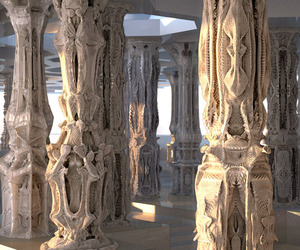 |
| Picture care of Atley & Folkert 2011 |
Hansmeyer's towering cardboard carvings have a tribal and botanical feel to them, which is both moving and unnerving at the same time. This makes me question the assumed distance between the electronic as the artificial and the biological as the authentic. There seems to be a closer relationship between the aesthetics of this contemporary artwork and the whole history of artistic expression than some of us might be willing to admit. We are after all simply organic computational devices capable of reproducing our thoughts within a physical space, so maybe what makes us so uncomfortable is dealing with technologies that have the potential to replicate the human experience in artistically exceptional ways that possibly move beyond what we can achieve without their assistance.
For me the era of electronic art represents a looming chapter of exceptional artistic creation, unparalleled beauty and limitless exploration of the digital aesthetic.
Bibliography:
Kasky, Atley G. & Folkert, Gorter. (2011) 'On the Generation of the Previously Unseen' on But Does it Float?, http://butdoesitfloat.com/1121006/On-the-generation-of-the-previously-unseen, accessed 24 May 2011
Murphie, Andrew (2011) 'Media Ecologies' lecture notes distributed in Advanced Media Theories at The University of New South Wales, Kensington Campus, 23 May 2011
Spaceweaver (2010) 'Introducing Japan's New Singing Robot', in AI, Culture, Robotics, Technology http://k21st.wordpress.com/2010/10/15/introducing-japans-new-singing-robot/, accessed 24 May 2011
Spaceweaver (2010) 'Introducing Japan's New Singing Robot', in AI, Culture, Robotics, Technology http://k21st.wordpress.com/2010/10/15/introducing-japans-new-singing-robot/, accessed 24 May 2011

No comments:
Post a Comment